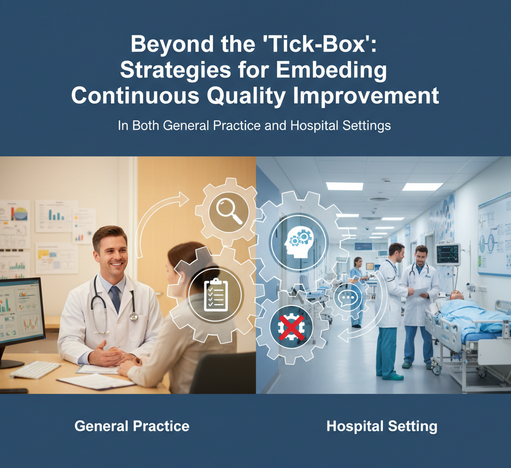
Continuous Quality Improvement in General Practice & Hospitals
Healthcare accreditation plays an essential role in safeguarding patient safety and service quality. However, for many organisations, accreditation can sometimes be viewed as a periodic exercise—a cycle of documentation, audits, and inspections designed to “pass the test.” While compliance is necessary, it is not the endpoint. True excellence in care emerges when organisations go beyond the tick-box and embed continuous quality improvement (CQI) into daily practice.
Whether in a large hospital or a small general practice, the principles of CQI—commitment, reflection, and proactive change—transform healthcare from reactive compliance to sustained excellence.
From Compliance to Culture
Accreditation frameworks such as general practice accreditation and broader healthcare accreditation standards establish fundamental expectations for safety and quality. However, the most successful healthcare organisations treat these frameworks as foundations—not final goals.
In a compliance-driven culture, staff often rush to update policies or complete training just before accreditation assessments. Once the assessment ends, momentum fades until the next cycle begins. By contrast, a CQI-driven culture continuously reviews, measures, and improves systems, embedding improvement into everyday workflows.
Building this culture requires strong leadership, engaged staff, and mechanisms for translating insights into action. The key is to move quality from being an administrative requirement to becoming part of the organisation’s identity.
1. Empower Frontline Staff to Drive Improvement
Continuous improvement begins with those closest to the work. Nurses, receptionists, allied health staff, and clinicians see firsthand where inefficiencies occur or where patient experiences can be improved. Empowering them to identify and act on improvement opportunities creates ownership and innovation.
- Create structured feedback loops: Establish forums, huddles, or regular debrief sessions where staff can share observations and ideas.
- Provide improvement training: Offer short, practical sessions on problem-solving frameworks like Plan-Do-Study-Act (PDSA) or root cause analysis.
- Recognise and reward innovation: Highlight staff contributions through newsletters, recognition programs, or small grants for pilot projects.
When staff feel their insights lead to tangible changes, engagement increases and CQI becomes self-sustaining.
2. Leverage Data for Iterative Learning
Data is the backbone of CQI. Instead of treating data collection as an end in itself, organisations should use it as a feedback mechanism to guide ongoing learning and refinement.
- Use real-time dashboards: Implement accessible systems that display performance metrics—such as patient satisfaction, infection rates, or appointment wait times—in real time.
- Analyse trends, not snapshots: Continuous analysis of longitudinal data helps identify patterns rather than isolated incidents.
- Share insights transparently: Communicating performance data across departments promotes accountability and fosters collaborative problem-solving.
For smaller general practices, this could mean regularly reviewing appointment turnaround times or patient feedback to adjust service delivery. In hospitals, it may involve monthly reviews of clinical incidents or length-of-stay data to drive multidisciplinary improvement initiatives.
3. Integrate Learning into Routine Operations
CQI thrives in environments where learning is constant, not confined to annual reviews or accreditation cycles. Integrating learning into daily operations helps maintain focus on improvement even amid clinical pressures.
- Daily or weekly improvement meetings: Brief, structured discussions on recent successes, near misses, or system failures encourage shared learning.
- Incorporate reflection into shift handovers: Encouraging staff to discuss what worked well and what could be improved embeds a reflective mindset.
- Use quality improvement as part of professional development: Linking CQI initiatives with professional learning goals helps align organisational objectives with individual growth.
Embedding learning mechanisms ensures that improvement is continuous, adaptive, and owned by everyone—not just quality managers.
4. Align Leadership and Strategy with CQI Principles
Sustainable improvement begins with leadership that values learning and transparency. Board members, executives, and practice owners play a critical role in modelling curiosity and accountability.
- Set clear, measurable goals: Align strategic plans with CQI principles by establishing measurable objectives for safety, patient experience, and workforce wellbeing.
- Encourage cross-functional collaboration: Quality improvement often cuts across departments; collaboration ensures systemic rather than siloed change.
- Invest in resources: Time, technology, and training are necessary to support improvement. Allocating dedicated time for quality meetings and analysis signals that CQI is a priority.
When leaders visibly engage with data, acknowledge challenges, and celebrate progress, it builds organisational confidence and credibility.
5. Embed Quality into Systems and Technology
Modern healthcare systems rely heavily on digital infrastructure. Integrating CQI principles into electronic medical records, incident reporting tools, and audit platforms can streamline improvement efforts.
- Automate feedback loops: Use electronic alerts or reminders to highlight non-compliance or missed safety checks.
- Centralise documentation: Shared digital platforms for audits, policies, and improvement plans improve transparency and consistency.
- Standardise processes: Checklists, templates, and clinical pathways ensure that best practices are consistently applied, reducing variation and risk.
These systems make quality management more efficient while freeing clinicians to focus on patient care rather than paperwork.
6. Maintain Momentum Beyond Accreditation
To avoid the dreaded “pre-accreditation scramble”, plan regular mini-audits, mock assessments, or peer reviews throughout the year. These checks will keep your team on their toes and reinforce quality as a day-to-day job.
Likewise, by encouraging departments to set quarterly improvement goals, you’ll keep that energy and focus going all year. Improvement projects can be as small as you want: medication safety initiatives, appointment accessibility projects—regular, iterative changes that over time create real cultural transformation.
Continuous quality improvement isn’t a “once a year” event. It’s a mindset. Accreditation can be an excellent structure and forcing function, but its value comes from using the process to drive reflection, learning, and continuous excellence.
Empower staff, use data wisely, focus on learning, integrate quality into everyday practice, and bake it into systems. Both hospitals and general practices can use the accreditation process to move beyond simple compliance and towards real transformation. In the end, CQI ensures that you’re not just “ready for the next accreditation visit”—you’re in a state of continuous improvement for the patients and communities you serve.



Post Comment